

Mediamonitor: Prices of flats to fall. Or not
Readers who want to make a picture about the future development of the prices of flats on the basis of the daily press definitely noticed many different and often quite opposite reports in April. They were given perhaps all conceivable scenarios: the prices will stagnate; flats will be cheaper; flats are already cheaper. There were also some rare voices that the prices of flats would go up. This is also obvious from an analysis performed by Newton Media, which surveyed the “presence” of property developers in national dailies, on the radio and on TV and in social and selected economic (E15, Euro, Ekonom, Profit) magazines in April.
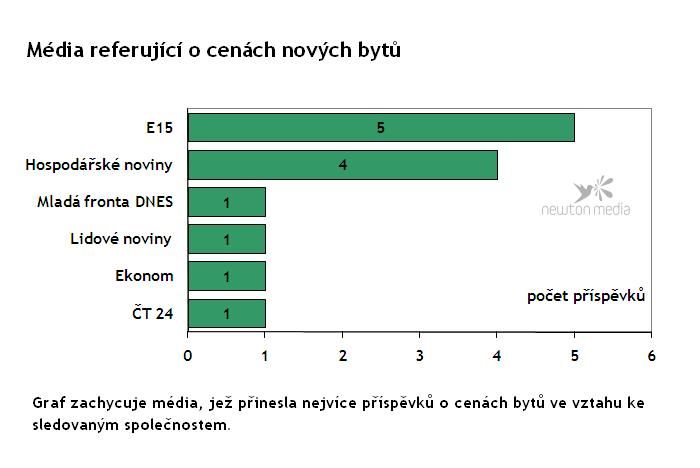 Among property development firms, the discussions on
the potential cuts in the prices flats mostly involved Central Group (see chart
1), which was often mentioned in connection with its offer of a car given with a
new flat or house. Otherwise, however, the company’s boss Dušan Kunovský
was rather sceptical in the media about the potential future price reductions in
case of new properties. According to him, the prices will be mostly cut by
property developers in trouble and by sellers of flats in prefabricated houses,
but otherwise we should expect stagnation and a subsequent price increase.
Kunovský described the company’s response to the dwindling demand in
Hospodářské noviny (10 April 2009) as follows: “We are preparing land but
it is meaningless to build anything new right now. When we sell one flat in a
project, we have to launch an investment of hundreds of millions, while the
demand is uncertain. If we want credits, the banks now require a high percentage
of pre-sold flats that a loan is not necessary any more. Now we will repay small
credits we have and will build from our own resources.”
Among property development firms, the discussions on
the potential cuts in the prices flats mostly involved Central Group (see chart
1), which was often mentioned in connection with its offer of a car given with a
new flat or house. Otherwise, however, the company’s boss Dušan Kunovský
was rather sceptical in the media about the potential future price reductions in
case of new properties. According to him, the prices will be mostly cut by
property developers in trouble and by sellers of flats in prefabricated houses,
but otherwise we should expect stagnation and a subsequent price increase.
Kunovský described the company’s response to the dwindling demand in
Hospodářské noviny (10 April 2009) as follows: “We are preparing land but
it is meaningless to build anything new right now. When we sell one flat in a
project, we have to launch an investment of hundreds of millions, while the
demand is uncertain. If we want credits, the banks now require a high percentage
of pre-sold flats that a loan is not necessary any more. Now we will repay small
credits we have and will build from our own resources.”
Rather down
 Similarly, an article in MF Dnes (10 April 2009),
based on statements by Finep’s Chief Finance Officer Štěpán Havlas,
mentioned that property developers responded to the crisis especially by curbing
their construction activities. Customers who look forward to distinct price cuts
can therefore forget about it. According to Havlas, the restrictions in new
construction will result in “enough high-quality flats in Prague when the
crisis is over, and their prices will therefore grow.” In the last ten days in
April, when the media responded to the data published by the Czech Statistical
Office, according to which the prices of flats in the Czech Republic had dropped
for the first time since 2005, Finep was nevertheless presented as one of the
drivers of price cuts, with discounts of over half a million crowns per flat.
According to the daily E15 (28 April 2009), the discounts could even reach up to
a million.
Similarly, an article in MF Dnes (10 April 2009),
based on statements by Finep’s Chief Finance Officer Štěpán Havlas,
mentioned that property developers responded to the crisis especially by curbing
their construction activities. Customers who look forward to distinct price cuts
can therefore forget about it. According to Havlas, the restrictions in new
construction will result in “enough high-quality flats in Prague when the
crisis is over, and their prices will therefore grow.” In the last ten days in
April, when the media responded to the data published by the Czech Statistical
Office, according to which the prices of flats in the Czech Republic had dropped
for the first time since 2005, Finep was nevertheless presented as one of the
drivers of price cuts, with discounts of over half a million crowns per flat.
According to the daily E15 (28 April 2009), the discounts could even reach up to
a million.
In addition to discounts, bonuses and marketing events, the media also paid attention to other possible ways how property developers could face the current slump in demand. Hospodářské noviny (1 April 2009) and the daily E15 (29 April 2009) brought information on the so-called voluntary auctions organized by Professionals. Customers should be especially attracted by low call prices, set at 70% of the ordinary call prices for the given real estates. However, the property developers’ response to this type of sale was mostly confounded. Similarly, when asked by E15 (8 April 2009) about the possibility to start building rented flats, the companies addressed mostly answered in the negative.
Orco still in the focus
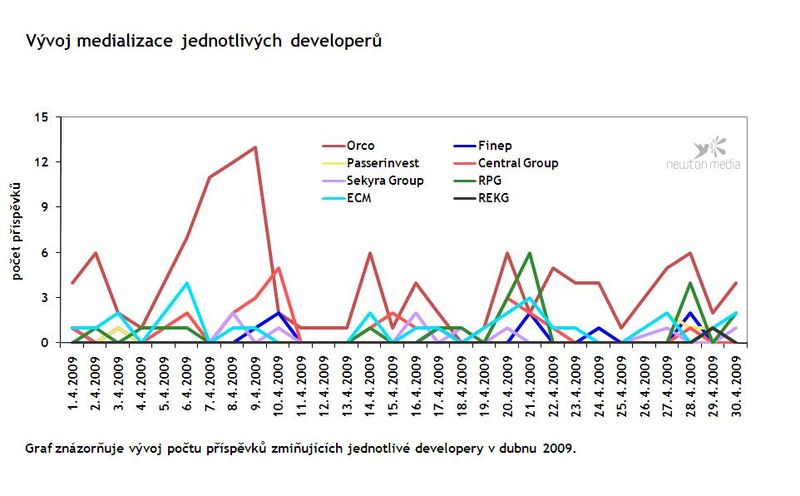
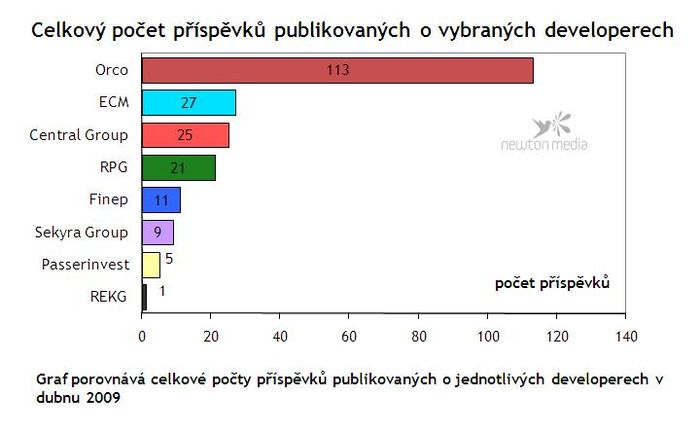 Just like in the months before, Orco was once again
mentioned most of all companies in the media in April. It made the headlines
primarily at the end of the first ten days in April (see chart 3), when it
announced the trading balance from the previous year, after several
postponements. The loss of EUR 390 million was mostly evaluated as “even
worse than we expected.” However, Jean-Francois Ott, Orco’s Chief Executive
Officer, was trying to be optimistic. In an interview for the weekly Euro Euro
(20 April 2009), he also said: “The loss that you describe as record-high is
not actually so massive. The value of Orco’s whole portfolio went down by
about fifteen percent. During a crisis as severe as the one we are seeing right
now, even a decline of about twenty percent is nothing shocking. (…) I see
the whole situation in the following light: sometimes the prices of real estates
are down, then they go up and, at some point in time, are corrected. Of course,
given the portfolio that Orco possesses, a decline in value by fifteen percent
yields a huge sum. But I really think that it is not so bad, given the current
crisis.”
Just like in the months before, Orco was once again
mentioned most of all companies in the media in April. It made the headlines
primarily at the end of the first ten days in April (see chart 3), when it
announced the trading balance from the previous year, after several
postponements. The loss of EUR 390 million was mostly evaluated as “even
worse than we expected.” However, Jean-Francois Ott, Orco’s Chief Executive
Officer, was trying to be optimistic. In an interview for the weekly Euro Euro
(20 April 2009), he also said: “The loss that you describe as record-high is
not actually so massive. The value of Orco’s whole portfolio went down by
about fifteen percent. During a crisis as severe as the one we are seeing right
now, even a decline of about twenty percent is nothing shocking. (…) I see
the whole situation in the following light: sometimes the prices of real estates
are down, then they go up and, at some point in time, are corrected. Of course,
given the portfolio that Orco possesses, a decline in value by fifteen percent
yields a huge sum. But I really think that it is not so bad, given the current
crisis.”
 Jagg.cz
 Linkuj.cz
 Google Bookmarks
 Live bookmarks
 Digg
Digg Del.icio.us
 MySpace
 Facebook